
Isabelle Faust: Eternal Beauty May Not Be the Most Exciting
The 2026 Gramophone Award-winning violinist on Ligeti, the historical recordings that have shaped her musical life, her approach to interpretation, and her enduring partnership with Alexander Melnikov.
 | By Lucy Cheung 16 October 2026 |

Isabelle Faust, who recently won Artist of the Year and the Concerto Award at the 2026 Gramophone Classical Music Awards, told me last week that she would be very sad not to be playing with Alexander Melnikov. After hearing them perform Brahms and Schumann together at Milton Court Concert Hall in London on 10 October, I understood exactly what she meant.
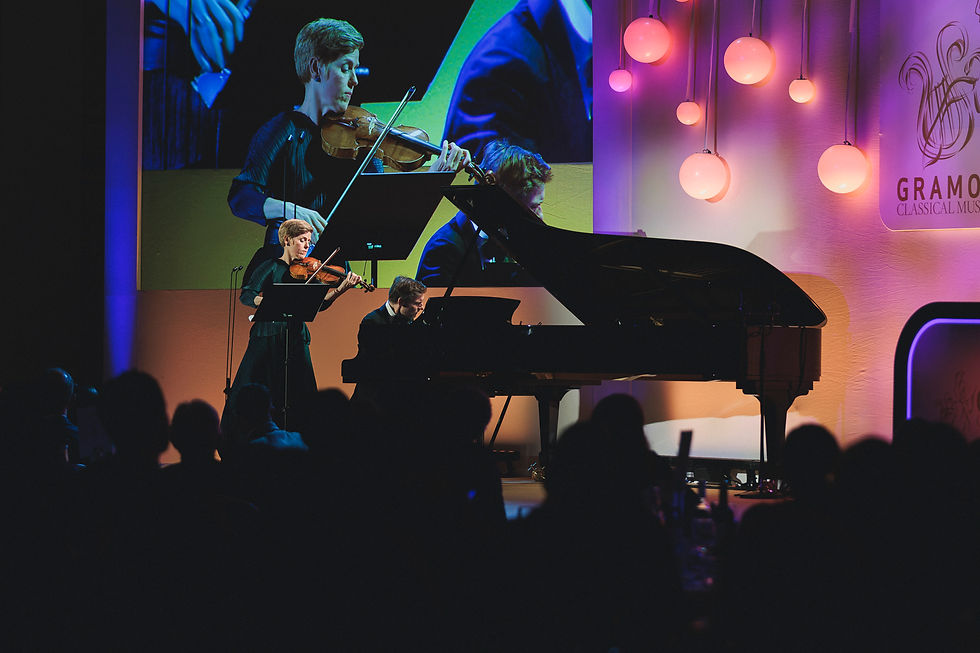
For her trip to London, Faust brought two violins: one for her performance at the Gramophone Classical Music Awards on 7 October, and another strung with gut strings for the concert two days later, when she would play alongside Melnikov on a restored 1875 Érard fortepiano.
The fortepiano’s open, woody resonance seemed to rise through the floorboards of an old upstairs room, setting the tone for the evening. Brahms’s Sonata in F minor, Op. 120 No. 1, originally written for clarinet and piano and later transcribed for viola in a version approved by the composer, took on a subtly different character in the violin version performed that night. The second movement was particularly moving, its shifting colours revealing a remarkable emotional depth. The pauses at the ends of phrases, the harmonic turns and the hesitations as the melody began again all seemed to reflect Faust’s restrained candour, maintaining a certain distance even at moments of intimacy. Sustained, unbroken breaths carried the long musical lines as they gradually opened out before settling into stillness, drawing performers and audience alike into the same season.
I was struck by the combination of a violin sound that could be raw, even abrasive, and the music’s quiet, autumnal narrative quality. The playing had an unvarnished directness, as frank as looking straight into Faust’s eyes. In the second half, Schumann’s Second Violin Sonata moved through shifting emotional landscapes. Its sombre undertow was occasionally softened by gentler passages, only to be broken by sudden, forceful surges from the piano. There was an edge to the exchanges between the two instruments, and at times a palpable resistance. Faust and Melnikov have been performing together since 1999, and the understanding between them has the substance of a partnership built over decades.
Ahead of the Gramophone Awards ceremony on 7 October, Faust spoke to The Riff Magazine about her award-winning recording of Ligeti’s Violin Concerto, the historical recordings that have had a profound influence on her, what she seeks in musical interpretation, and her more than two decades of making music with Melnikov.

A Conversation with Isabelle Faust: “We Will Never Lose Each Other”
LC: Lucy Cheung
IF: Isabelle Faust
Ligeti’s Violin Concerto
LC: Ligeti’s music is not generally regarded as part of the traditional classical canon. When you decided to record his Violin Concerto, what did you most want listeners to hear in the work?
IF: In 2023, there was a year of celebrations marking Ligeti’s centenary, so a great deal of his music was being performed. It was no coincidence that we toured with the concerto that year, either. Otherwise, I think it would be quite difficult to organise an entire tour around Ligeti’s Violin Concerto. But that year, there was a particular focus on his music, so I think people had more opportunities to get to know his works.
The Violin Concerto is one of those pieces that are, in a certain sense, very accessible. The Horn Trio is another example. I feel that these works speak very directly to people. Of course, they are intellectually sophisticated and very carefully structured, but they also have a strong emotional drive.
The writing is wonderfully varied, too, with each movement very different from the others. Ligeti manages to create astonishing sound pictures through the way he combines the violin with the orchestra. At times, the effect is almost impressionistic, while at others it is extremely powerful. The concerto is almost like a very exciting story told through the violin, and I think listeners can form associations with it quite easily.
That is probably why the concerto is regarded as a stroke of genius and has already become a modern classic. I cannot think of many contemporary violin concertos from recent years that are already being performed by so many of my colleagues. We can be sure that this one will remain in the repertoire for a long time.
LC: If we look at the results of the Gramophone Awards in recent years, for example, we can see a growing variety of repertoire. As a performer, do you feel that the classical canon, as we call it, has been changing over the years?
IF: I think it is really a matter of simple arithmetic. There are only so many recordings of Beethoven’s Violin Concerto, or of the Brahms and Mendelssohn concertos, that you can have at home. At some point, you naturally become curious and want to discover something new. I suppose that is simply the way things work when it comes to recording.
LC: When you research a piece, such as Ligeti’s Violin Concerto, what is your process?
IF: Of course, I always start by looking at the score, because you have to understand what the piece is about. I also think it is very important to listen to or study other works by the composer. In Ligeti’s case, as I mentioned, the Horn Trio is very closely related to the Violin Concerto, and I had already performed the Horn Trio quite a lot. So when I began studying the concerto, certain similarities immediately caught my eye and ear.
Naturally, you also try to find out how your colleagues approach the piece and how it might be interpreted in different ways. But in the end, you have to return to the score, while also exchanging ideas with your colleagues, because you are all in the same boat.
You also look into the history of the work. Saschko Gawriloff was the violinist who gave its premiere, and it is interesting to see how the piece has developed over the years.
LC: If you compare performances today with those from earlier years, what differences do you notice in the interpretations?
IF: I think a piece always needs time to mature. When you give the premiere of a work, you are actually the person who has had the least time to understand it. Of course, you are normally the one in closest contact with the composer, but the piece is still very new to you.
A work needs to be digested; it needs to live through performances. Sometimes it is also changed or rearranged. Most composers still want to make adjustments after a premiere, so every piece develops its own history.
After a few years, the work will naturally sound different. The composer may understand it differently, and the interpreter certainly comes to know more precisely what can be brought out of it. I think it is probably easier for us today to get to the bottom of the piece than it was when the score was still wet, so to speak.
Of course, being able to discuss the music directly with the composer and ask what he meant by a particular passage, or whether he might consider changing something that is awkward to play on the violin, is a tremendous privilege for the musician giving the premiere. But even that first interpreter will play the piece differently ten years later. That is part of the beauty of it.
LC: Your repertoire spans many periods, from Bach and Beethoven to twentieth-century and contemporary composers. When you move between composers and periods, can studying one composer in depth change your understanding of another, perhaps allowing you to discover things you had not noticed before?
IF: I am sure it can. I think you might play Schumann differently if you had not immersed yourself in studying Bach, for example. Schumann admired Bach enormously and knew his music very well. Even when he is not directly quoting Bach, he is deeply influenced by him, as so many other composers are. If you are not aware of that connection, Bach might not immediately come to mind when you play Schumann.
Throughout the centuries, great composers have always studied the music of those who came before them. There are direct connections between works from different periods, and it is fascinating to trace those links and understand where a particular composer’s musical language comes from.
Historical Recordings
LC: Today, on the day of the Gramophone Awards, we are celebrating recordings. Are there any historical recordings that mean a great deal to you?
IF: There are many, of course. The recordings that move me most are those by the Busch Quartet. I find them extremely touching and very special. They represent such a distinctive way of making music, almost something apart from everything else, and it is difficult to put into words.
For me, that way of making music is so authentic. I always return to the Busch Quartet’s recordings, and I also listen to Adolf Busch himself as a violinist. I admire him greatly, both as a musician and as a person.
I also have a portrait of Joseph Joachim, who is another great idol of mine, although we have only a very small number of recordings of him from his later years. He played a crucial role in the creation of so many masterpieces and stood at the centre of musical life in his time. I think he influenced so many musicians over a very long period. He was a major voice in his day.
And if we stay with violinists, I am also a great admirer of Joseph Szigeti, among many others.
Musical Interpretation
LC: A critic friend of mine has a question for you. He has noticed that you do not always pursue the kind of beautiful, pleasing sound that people might conventionally expect from a violinist. What are you looking for when you play?
IF: I am not really looking for a particular sound when I play. What I try to do is give the music a real story, a real picture. Sometimes the music has to hurt; sometimes it is troubled; sometimes it is almost like flying through the sky.
I do not think in terms of wanting to produce one kind of sound or another. I do not necessarily think in terms of playing the violin, either. Sometimes a rougher sound may emerge, but it is not that I consciously decide to make it rough.
I always try to give the music a real face, according to how I understand the score. And I think eternal beauty may not be the most exciting thing. Of course, there have to be beautiful moments, but there also have to be less beautiful ones. Otherwise, the beautiful moments would no longer stand out.
Even so, I do not consciously think in those terms when I play. To answer your question, I do not decide that one note should be beautiful and another rough. That is not how I make music.
Alexander Melnikov
LC: You and Alexander Melnikov have been working together for more than twenty years. What was it that made you click as musical partners?
IF: He is such an outstanding, extraordinary musician and a wonderful, wonderful person. He is one of the most important friends in my life.
He would remember exactly which year we met; I never do. But it was more than twenty years ago, at a chamber music festival in Oxford. We both thought the other was playing incredibly beautifully, and we decided that we wanted to perform sonata repertoire together.
We then decided to take the duo seriously as a real partnership, rather than playing with one pianist one day and a different violinist the next. We approached it almost as a string quartet would, working to find a voice of our own together in the sonata repertoire.
At some point, I wanted to record some trios, so we invited Jean-Guihen Queyras to join our little circle. That worked very well, too. They are my two long-term chamber music partners. We meet and play together regularly. Some seasons we have more concerts together; in others, everyone is busy with other things. But the collaboration always comes back and continues. I think we will never lose each other.
LC: What do you think is particularly special about the partnership? You are going to perform Schumann and Brahms together on Saturday. What is it about playing with Alexander that makes those performances distinctive?
IF: I always find that difficult to answer, because it is really for other people to judge. From my point of view, I would probably be very sad to play this repertoire with anybody else.
Alexander is an extraordinarily sensitive musician in every sense. Of course, he knows me very well. I only have to breathe, and he knows where I am going. It works the other way around, too: I know how to read him.
We also share a similar background, if you like, and a common interest in historical instruments. We encouraged each other to explore that world. We had friends in that musical circle in common, and we learned from them together.
I encouraged him to build what has become his incredible collection of period instruments. He has so many wonderful instruments now. It is lovely to go to his place and ask ourselves what repertoire we have not played yet, only to discover that he has exactly the right instrument for it. Of course, that is a rather self-serving way of looking at it from my side!
But we went through this whole development together. We share the same outlook on this music, and we are both flexible. We do not insist dogmatically on using period instruments; early music can also be played beautifully on modern instruments.
Nevertheless, that experience feeds into our performances even when we are not using period instruments. We have the same sound world in our ears, and that makes the collaboration very special.

The Beethoven Recording Project
LC: Last month, I met Jean-Guihen Queyras here in London, and he told me that you were going to record some Beethoven together next year. Is that right?
IF: Yes, we are continuing our Beethoven series. It has been planned for a long time, but somehow it never happened. Now we are finally doing the whole thing.
LC: Beethoven’s bicentenary is coming up, so I imagine there will be quite a few projects around his music.
IF: Yes, although we are a little late with ours. We will probably only have finished recording by the end of next year, so the release will come a little later. The timing is not ideal! But the project was not conceived specifically for the Beethoven anniversary.
The trios are absolutely fantastic. Each one is a little jewel. They form a major part of the piano trio repertoire, and we have played them a great deal. We have played the “Archduke” Trio and recorded the Trio in E-flat major, Op. 70 No. 2. We have performed the other trios as well, but not so often, and it has been a long time. Our plan is now to record the complete cycle. None of us is getting any younger, so we have to do it!
LC: At this stage of your life, are there one or two composers you feel particularly close to?
IF: When I plan programmes, I naturally choose composers whose music I like. At the moment, I am preparing a new work for its premiere, but it is still a little too early to say exactly what it is.
Normally, I know what I am going to be working on, and I would always like the pieces I agree to perform. Otherwise, I would not agree to play them. And then, of course, my feelings for a work often become more intense as I get to know it more closely.
I think Beethoven was one of the composers I came to feel close to a little later than others. Perhaps Mozart, too. I am talking about a long time ago, of course. Beethoven may not be a composer you immediately embrace at the age of eighteen. I have heard other people describe a similar experience. I always loved Beethoven, but his music has gradually grown under my skin.
LC: Why do you think that is?
IF: I do not know. I cannot really tell you. I fell in love with Brahms very early, for example, and I have always loved Schumann. He is not a composer everyone immediately loves, but somehow his music has always been with me. Bach, of course, has always been there, too.
Mozart’s music was always there, but it took me a little longer to recognise the real genius of this composer. I would say the same about Beethoven. Mozart is astonishing. With such limited means, he achieves results that are completely unique. So many composers have tried to imitate him, or have used similar means, but there is a touch of genius that belongs to Mozart alone.
Beethoven, of course, is more elaborate in a certain sense. But what he achieved is simply monumental. If you look at the Grosse Fuge, for example, or consider how far he went beyond the musical conventions of his time, it is extraordinary.
These are things you may need to reflect on before you can fully appreciate them. You develop a profound respect for the music, and then somehow that respect becomes part of your emotions. At least, that is how it happened for me.
| Writer |

Comments