
Bertrand Chamayou: Mendelssohn Has Been Misunderstood
French pianist Bertrand Chamayou on his fascination with Mendelssohn’s Songs Without Words, and the ever-evolving musical universe that connects the composers he plays.
 | By Lucy Cheung 12 October 2026 |

Fresh from winning the Piano Award at the 2026 Gramophone Classical Music Awards, alongside Norwegian pianist Leif Ove Andsnes for their album Schubert 4 Hands, French pianist Bertrand Chamayou appeared at Wigmore Hall on 9 October. He was joined by Norwegian violinist Vilde Frang and brothers Benjamin and Salamon Eredics in a programme built around 20th-century works by Bartók and Kurtág, bringing together the folk traditions of Central and Eastern Europe and the Balkans, as well as elements of improvisation.
The richly varied concert was one of Chamayou’s appearances as Wigmore Hall Artist in Residence this season. Bartók’s Violin Sonata No. 1 and selections from Mikrokosmos were woven together with passages from Kurtág’s Játékok (Games), bringing classical music, folk traditions and improvisation into dialogue. The programme also included improvisatory passages incorporating elements of Arabic music. The Eredics brothers’ arrangements of Hungarian, Romanian and Serbian folk music moved between an array of instruments, including violin, accordion, trumpet, shepherd’s pipe, hulusi, guitar and piano.
I caught up with Chamayou briefly at the Gramophone Classical Music Awards on the evening of 7 October, towards the end of the ceremony. We spoke for around 20 minutes about his approach to different musical traditions and improvisation, as well as his forthcoming recording of Mendelssohn’s Songs Without Words, due to be released this week.
Andsnes was absent from the awards ceremony that evening. In an interview with The Riff Magazine last week, he recalled his first performance with Chamayou in 2016, when they played Schubert’s Fantasia in F minor, D. 940, for piano four hands at the inaugural Rosendal Chamber Music Festival. The experience revealed an immediate musical affinity, which led the two pianists to explore more of Schubert’s four-hand repertoire together.
It was approaching midnight by the time I spoke to Chamayou. Looking at his flushed face, I realised that most of us had had a few drinks and were feeling a little more relaxed, if also slightly tired. Yet even as his gaze occasionally wandered and his sentences came in a rapid, almost stream-of-consciousness flow, his thinking remained clear, and he was unfailingly considerate towards those around him. Chamayou will return to London in early November, when we will bring readers another installment of The Riff Questionnaire, with a slightly sharper set of questions.
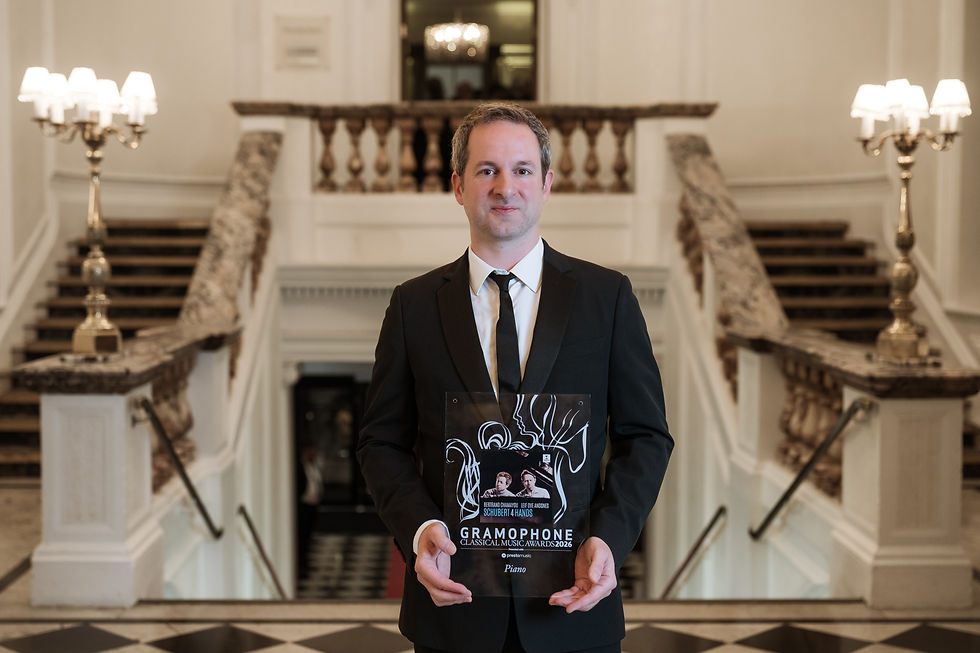
In conversation with Bertrand Chamayou
LC = Lucy Cheung
BC = Bertrand Chamayou
Improvisation, folk traditions and musical freedom
LC: Your programme at Wigmore Hall moves beyond Bartók and Kurtág to include folk music and improvisation. What does improvisation mean to you?
BC: I’m not actually improvising in that concert. But, anyway, what does improvisation mean to me, even if I’m not directly improvising this time? Improvisation is still part of the programme.
I’ve always improvised, ever since I was a child and first started playing the piano. At the beginning, interpreting music, reading music, composing and improvising were all part of the same thing for me. Of course, later on I devoted myself more to interpretation.
But composition and contemporary music have always been at the core of my work, and improvisation is somehow part of that too. Some music can be very close to improvisation. Kurtág’s music is a good example: in some pieces, the pitches are not entirely fixed, and the performer has to find them. The score becomes more of a gesture. In that sense, there is something improvisatory about it.
In this concert, though, it was a little different. We started with one major sonata, Bartók’s Violin Sonata No. 1. It’s a monster of a piece, lasting around 45 minutes. I think it is the biggest and heaviest sonata of the 20th century — something like the 20th-century equivalent of Beethoven’s Kreutzer Sonata.
We built the programme around it, together with two wonderful traditional musicians, the Eredics brothers, Benjamin and Salamon. They play all kinds of instruments — around ten or fifteen of them appear on stage. We created the programme together, and I also play some pieces from Bartók’s Mikrokosmos and Kurtág’s Játékok. We start from these Hungarian roots and develop the programme from there.
We also play arrangements of traditional music with Vilde, Benjamin and Salamon. These pieces are close to improvisation too. Some things are written down, but the way we approach them is more like an oral tradition. It isn’t music that is entirely fixed in notation.
LC: As Artist in Residence at Wigmore Hall this season, what do you want audiences to discover about you?
BC: I love creating programmes, and I love movement. I don’t like things that are too rigid. I like to present myself in different ways, and I love diversity. Whenever I have a residency somewhere, it gives people an opportunity to see a particular aspect of my work. This isn’t my first residency at Wigmore Hall, for example, and this time I have three concerts.
One is a recital centred on Mendelssohn’s Songs Without Words, which is quite an exciting programme. I intertwine the pieces with some more contemporary music, creating a complete programme around the idea of what a song without words might be.
I also have a programme with Barbara Hannigan, centred on music by Erik Satie and John Cage. So these are three very different projects. Of course, I would be happy to present twenty or twenty-five projects, if I could, and show people even more different aspects of my work.

Mendelssohn and the meaning of a song without words
LC: I was going to ask you about Songs Without Words. You have a new album coming out. What does the idea of a song without words mean to you, and why have you chosen to explore it in this way?
BC: The next album is entirely devoted to Mendelssohn. It’s a very pure Mendelssohn recording: I’ve recorded the complete Songs Without Words, all 48 pieces, nearly two hours of music. I wanted to create a very clear, unbroken thread, almost like a diary of Mendelssohn’s life.
First of all, I think this is marvellous repertoire, and it hasn’t been recorded all that often in its entirety. Five or six of the pieces are extremely famous, but the others are much less well known. I think the whole collection is of the highest quality. The music is extraordinary, and it deserves to be heard.
I’ve also recorded another album, which hasn’t even been edited yet. It will be called Songs Without (Good) Words. It includes a wide variety of pieces that pay tribute, in different ways, to the idea of a song without words.
The recital programme I’m currently performing includes around twelve of Mendelssohn’s Songs Without Words, interwoven with other kinds of songs. There’s a Beatles song arranged by Takemitsu, for example, as well as works by Schumann in transcriptions by Liszt, and other pieces.
The second half features two major fantasies built around this idea. One is Schubert’s famous Wanderer Fantasy, which he composed around his song Der Wanderer. The other is a 21st-century work by the American composer George Crumb, Eine kleine Mitternachtmusik. It is a series of variations, almost a large-scale fantasy, based on the jazz tune ’Round Midnight by Thelonious Monk.
LC: Do you play jazz yourself?
BC: No. I mean, I love jazz, and I love many different kinds of music, but I really believe that we can’t be as good at something as people who live with it all day long. That’s what I do with classical music, particularly with certain composers. You have to be familiar with the language of a musical tradition if you want to play it well.
So I can play a little jazz and try things like that, but I wouldn’t be as good as I would like to be, especially compared with the many wonderful jazz pianists I admire today. Sometimes I might do projects that bring me into dialogue with musicians from other fields, but otherwise I want to stick to what I can do best.
LC: Why record the complete Songs Without Words now? Was it a deliberate plan, or did the idea come about by chance?
BC: It’s always a question of chance, but not entirely. I think there is also a kind of timing that has to do with where you are in life.
Around twenty years ago, I recorded a solo album of Mendelssohn’s music for the label Naïve. It was one of my first solo albums, and I included quite a few lesser-known pieces, among them five of the Songs Without Words. To choose them, I actually sight-read the entire collection. There are eight books, with six pieces in each, making 48 in total. I was amazed by their quality, because I didn’t know most of them at the time.
I remember thinking that I was making a Mendelssohn solo album with all kinds of things — preludes, fantasies, variations and so on — but perhaps I should consider recording the complete Songs Without Words one day, because the collection hasn’t been recorded in its entirety all that often.
That thought stayed with me. It remained on my wish list, and gradually grew. Then, at a certain point, I had the intuition that the timing was right. So I would say it was somewhere between a plan and a coincidence.

‘Mendelssohn has been misunderstood’
LC: It seems relatively unusual for a pianist to devote an entire recording to Mendelssohn. What draws you to his music? I don’t often hear people talking about his compositions, and sometimes I get the impression that they are considered a little superficial, perhaps too polished or elegant.
BC: Yes, Mendelssohn has been misunderstood. First of all, he wasn’t an avant-gardist like Liszt, Wagner or Berlioz. Even Chopin was, in a way, a modern composer. Mendelssohn wasn’t a particularly dramatic composer, at least not in the way Schumann or Schubert could be.
That has something to do with his personal life, too. He came from a very wealthy family and was very successful. He wasn’t really struggling, and his music isn’t really about struggle. Instead, it is crafted with extraordinary skill. It is full of inventive ideas, and above all it is joyful and colourful.
Of course, when you go through the Songs Without Words, which span his life, you can feel that towards the end he begins to explore more dramatic territory. But he never really plunges into the depths of emotion. There is always a kind of veil, somehow, which I find very touching.
He grew up in a different world. He was already successful when he was composing his early works, at a time when Beethoven, Schubert and Weber were still alive. In a sense, his musical language was more closely connected to the past than to the future. That is why many people have regarded him as a good craftsman: very bourgeois, elegant and refined, perhaps not such a profound composer.
But I don’t think that is true. I love Schumann’s music, of course, and when you really delve into it, you find extraordinary depth. Schubert can be so melancholic, so extreme and sometimes so unsettling that his music really shakes you. Mendelssohn may not shake you in the same way, but for me, listening to his music is like seeing a whole spectrum of colours. It gives me enormous pleasure. There is so much invention, so much creativity, and sometimes such joy. That is valuable in itself.
There are incredible ideas in almost every bar, and the music makes me very happy. But it isn’t only about happiness. When I recorded these songs, I went through all kinds of emotions, and I was surprised by the diversity of feeling contained in such short pieces.
What I find particularly moving is that even when Mendelssohn has something very melancholy to express, he never does it in a showy way. His expression is very intimate, very personal. I find that deeply touching. His music brings about very special emotions, which are always on the edge.
I’m very much in love with this music. I was so pleased to record all 48 pieces, and I’m proud that the album will be released soon.
A musical universe of many constellations
LC: You have a very diverse musical practice, and you work with so many different composers. At this point in your life, is there one composer who feels particularly close to your heart?
BC: I can’t really say. There are too many. I spend a lot of time with Ravel, for example, because I’m curious about him and play his music all the time. I’m also creating a festival, so I’m quite obsessed with him at the moment. But there are so many composers I love.
I also enjoy discovering new music, particularly contemporary music. I’m constantly commissioning new works. Next month I’ll be premiering two or three new pieces, and I already have many more premieres planned. I love that diversity, so it’s very difficult for me to single out just one composer.
Even at the moment, I’m working on so many different things. For this season, I have a pile of Viennese music to learn — more than 3,000 pages. I’m very happy with all of it, but I find it difficult to give a single answer when there is so much going on.
LC: Do all these projects influence one another? Or do you keep them separate, concentrating on one thing at a time?
BC: They do influence one another. I like to put things into perspective. For me, it’s a big journey, almost a kind of creative process, in which I bring together all these musical works to build my own musical universe — or galaxy, I don’t know what to call it.
It’s a constellation of things that don’t necessarily have obvious connections, but somehow I manage to bring them together. Sometimes those connections aren’t the ones you find in music-history books. I like the element of surprise, when you suddenly discover links that are unfamiliar, or perhaps even unconscious.
| Writer |


Comments